
| 일 | 월 | 화 | 수 | 목 | 금 | 토 |
|---|---|---|---|---|---|---|
| 1 | 2 | 3 | 4 | |||
| 5 | 6 | 7 | 8 | 9 | 10 | 11 |
| 12 | 13 | 14 | 15 | 16 | 17 | 18 |
| 19 | 20 | 21 | 22 | 23 | 24 | 25 |
| 26 | 27 | 28 | 29 | 30 |
- 작법서
- 발더스 게이트 3
- 프리랜서
- 해깨마
- 시간을찾아떠난소년
- 티스토리챌린지
- 할로윈이벤트
- 예술활동증명
- 웹툰어시스턴트
- 해리포터깨어난마법
- 게임 리뷰
- 책 리뷰
- 영화리뷰
- 책리뷰
- 마비노기삼하인
- Astarion
- 마비노기
- 오블완
- 장송의 프리렌
- 에린에 찾아온 프리렌
- 마비노기이벤트
- 해리포터
- 서평
- 영어공부
- 듀오링고
- BG3
- 책추천
- 예술인패스
- 마비노기 장송의 프리렌 콜라보
- 마블유니버스
- Today
- Total
꿀배의 소소한일상
[Character Analysis] Baldur’s Gate 3: Let’s Take a Look at Astarion Ancunin – A Character Study (Act 1–2, Romance & Dark Urge Events) 본문
[Character Analysis] Baldur’s Gate 3: Let’s Take a Look at Astarion Ancunin – A Character Study (Act 1–2, Romance & Dark Urge Events)
뜨끈한 꿀배 2026. 3. 13. 20:41
Baldur’s Gate 3 is a game I started in 2023, and my total playtime has now reached 502 hours. Since I’ve spent so long focusing on this single game, my screenshot folder alone has grown to 29GB. While organizing them, I felt it would be a shame to keep them all to myself… so I thought it might be interesting to write some character analysis posts based on them.
I’ve occasionally posted character analysis pieces about works such as <Avatar: The Last Airbender>, <Harry Potter: Magic Awakened>, and <Venom>. It seems that people who love a character tend to examine them from every angle and look for different interpretations, which may be why those posts continue to receive steady views. Sharing an aspect of a character I love with others online is also something I personally find very enjoyable.
Anyway, the first character I’ll be analyzing from <Baldur’s Gate 3> is Astarion. Within the BG3 fandom, Astarion is an incredibly popular character. Thanks to Neil Newbon’s performance as the voice actor, Astarion has received a great deal of love that goes beyond just his appearance (or character model). When I first saw his face, my reaction was, “Is he really that popular?” But after spending time with him in the game, I ended up growing quite attached to him.
As the title suggests, today’s post will cover Act 1—from the first meeting with Astarion—through Act 2, including the romance route and the Dark Urge events. I’ll probably cover Act 3 next time, especially the Ascension and non-Ascension routes.
‼️Before we begin, I want to make it clear that everything below is simply my personal interpretation of the character. It is not an objective answer, but merely my impressions—and from start to finish, this post contains spoilers.‼️
⚠️Additionally, I am not a native English speaker. This article was originally written in Korean and translated into English with the help of ChatGPT, so some expressions may sound slightly awkward. I appreciate your understanding.⚠️
Character Information
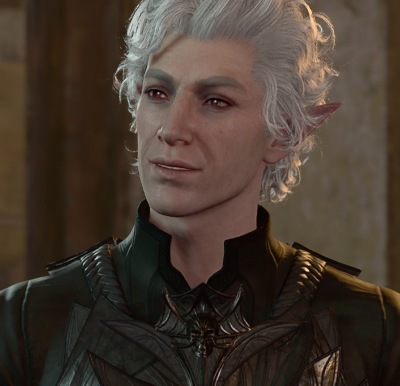
| Astarion Ancunín | |
| Basic Information | |
| Nicname | Pale Elf |
| Race | High Elf |
| Background | Charlatan |
| Class | Rogue (Arcane Trickster) |
| Alignment | Neutral Evil |
| Life | |
| Birth | 1229 DR |
| Death | 1268 DR (Age39) |
| Undead Resurrection | 1268 DR~ |
Hello, darling. Don't be shy, I promise not to bite until we've been formally introduced.
My name's Astarion, and I've spent a century stalking the night, hunting for pretty morsels just like you.
A man called Cazador made me what I am, kept me like a pet, and forced me to do his bidding.
No more.
The tadpole's influence broke his dominance over me, and now I can finally pursue the one thing I've hungered for these long, dark years. Revenge.
I'm going back to Baldur's Gate, to track Cazador down in his lair.
I'll be the last thing the bastard ever sees.
Origin Character Official Introduction Video Dialogue
Performance-related details were not included, as they are not necessary for this character analysis. The information above was taken from the Forgotten Realms Wiki. If you are curious about other details, you can visit the site below.
Astarion Ancunín
Astarion Ancunín, was a high elf rogue and vampire spawn who dwelt in Baldur's Gate during the late 15th century DR.[1] As an undead, the noble high elf had very pale skin, short silver-white curly hair, bright ruby eyes, an athletic build, and, by human
forgottenrealms.fandom.com
Act 1: An Irritating Complainer
The first meeting with Astarion is not particularly pleasant. Astarion deceives the player (Tav or the Dark Urge), claiming there is a monster in the forest and appealing to their sympathy. The moment the player lets their guard down, he presses a dagger to their throat. It’s a fitting move for someone of the rogue class, though depending on the dialogue choices, if the player notices the boar and willingly offers to hunt it, Astarion does not immediately draw his dagger.
In Act 1, Astarion feels like a pinball that could bounce anywhere. He strongly dislikes helping people and constantly nags the player, insisting that we have things to do and shouldn’t stray off course. He is a contradictory character who fundamentally distrusts others, yet enjoys being trusted without question himself. Because of this, there was even a playthrough where his approval was only 16 by the time we reached Act 2 out of my nine runs. His trademark cynicism and sarcasm can be the biggest obstacle for players with a good-aligned playstyle who enjoy helping NPCs.
In truth, Astarion’s attempt to seduce the player in Act 1 can feel rather abrupt. Moments like when he suddenly lies back and says, “The moon is beautiful tonight,” feel a bit out of place… No matter how charming Astarion is, it’s strange that after spending the entire day complaining about helping others, he suddenly uses such an old-fashioned (?) romantic tactic. Perhaps because it’s still early in Act 1, Astarion hasn’t yet fully grasped the unusual nature of the journey. If you succeed on a perception check, you can notice that Astarion doesn’t genuinely have feelings for the player and is simply trying to keep them around with a lie.
Neutral Evil Alignment
Astarion is classified as Neutral Evil in the official alignment system of the Forgotten Realms. In the D&D setting, Neutral Evil typically represents a form of evil that is selfish and pragmatic. Those of this alignment do not remain firmly on the side of good, law, or chaos. If a situation benefits them, they can easily align themselves with whichever side is advantageous. As a result, Neutral Evil often combines cruelty with a certain kind of rationality.
On the night when the player sides with the goblins and massacres the tieflings, speaking with the companions at camp reveals their reactions. Wyll and Karlach condemn the player and leave the party. Shadowheart, seemingly confused, keeps drinking heavily. Gale criticizes and resents the player, yet remains if persuaded—making him a rather loyal friend in that moment. Meanwhile, the only ones who appear completely unfazed are Lae’zel and Astarion. Evil-aligned companions do not bat an eye.
Astarion’s personality structure is close to a combination of self-centeredness and instrumental aggression. Instrumental aggression refers to the use of violence as a means to achieve a specific goal. Astarion tends to remain indifferent to the player’s choices as long as they do not harm him personally. The tiefling massacre does not present a moral dilemma for him. Whether the goblins are slaughtered or the tieflings are wiped out, his emotions are not particularly shaken. What matters to him is simply whether the outcome ultimately benefits him
This kind of “goal-oriented indifference” lies at the core of Neutral Evil. He views relationships with others primarily as tools for survival and maintaining power. This is why Astarion does not leave the party even after the companions slaughter the tieflings. Conversely, even if the goblins are wiped out and the tieflings are saved, he does not respond with great emotion. What matters is that he has survived—and that he has moved one step closer to the next stage.


Therefore, players who have built up enough approval with Astarion and entered his route can see this line. Astarion does not dwell on whether the outcome was the slaughter of the tieflings or the defeat of the goblins. Instead, he is more concerned with how to keep the player character tied to him once again. Here, we can see that the dialogue changes subtly depending on the situation. This suggests that Astarion tends to treat any choice as something already in the past while simultaneously turning it into material to seduce others again. In the end, this scene serves to show that he is not simply making impulsive jokes, but is already acting deliberately as a “seducer.”
Learned Cynicism and Sadistic Amusement
What is even more interesting is the nature of Astarion’s jokes. He seems to derive a certain kind of pleasure from the pain and distress of others. For example, when Lae’zel pressures and threatens the tiefling Zorru, Astarion clearly finds the situation amusing and genuinely enjoys watching it unfold. Seeing someone trembling in fear seems to provide him with a kind of safe zone—one where he feels he holds the position of power. In a world divided between sadists and victims, Astarion willingly climbs into the role of the aggressor in order to avoid ever being dominated again. That is why he appears unimpressed by threats that do not draw blood, dismissing them as “boring.” A cynical detachment, mockery, and a lack of empathy—these form the foundation of his personality.
Of course, in Act 1, several companions besides Astarion also display rather unruly tendencies. Still, whenever Astarion’s sadistic side stood out in particular, I often found myself thinking, “He’s such a popular character—why is he like this…?” Now, however, I understand the context of his unusual circumstances and his distorted survival instincts much better. At the same time, it is hard to deny that these contradictions are exactly what make Astarion such a multidimensional and fascinating character.
Cazador’s Domination – The Tragedy of a Vampire Spawn
Astarion suffers from an intense thirst for blood. The fact that he is a vampire spawn who has been unable to properly feed throughout the journey is, as a Korean, particularly horrifying to imagine. (Even if someone is imprisoned, shouldn’t they at least be properly fed?) The event where he secretly tries to bite the player’s neck at night and is caught can be interpreted as a sign that his hunger has reached its limit. At the same time, it also seems to reflect his curiosity about how far he has truly escaped Cazador’s control. In this scene, the player can choose to kill Astarion immediately—or forgive him and allow him to remain as a companion.
Reluctantly, Astarion reveals to everyone that he is a vampire spawn. Although the companions react with strong criticism, they ultimately decide to set it aside and move forward together for the sake of their shared goal. If you continue to question him during the journey, Astarion eventually confesses that he is not a full vampire but a vampire “spawn,” someone who has lived under the domination of his master, Cazador. In truth, he had to do whatever was necessary simply to survive.
The next event can be seen in Act 1 if your approval with Astarion is high enough. There are two possible variations. One occurs immediately after waking up from spending the night with Astarion. The other occurs at camp, where Astarion is seen shirtless, tracing the scars on his back with his hand. If the player character is a tiefling, they can roughly understand the meaning behind the scars through a narration similar to the one shown in the image below.

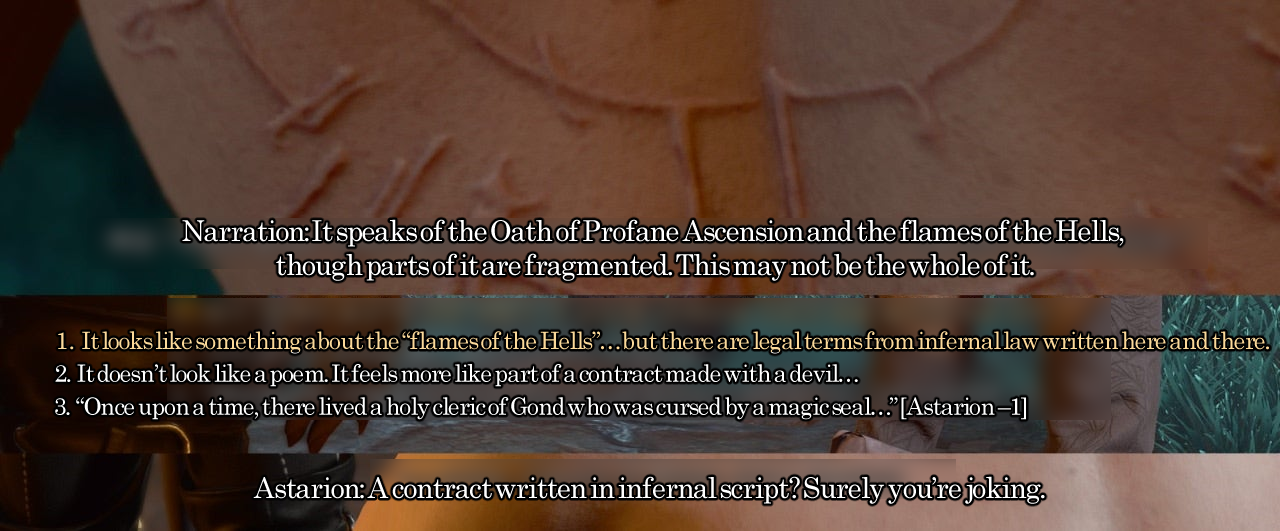
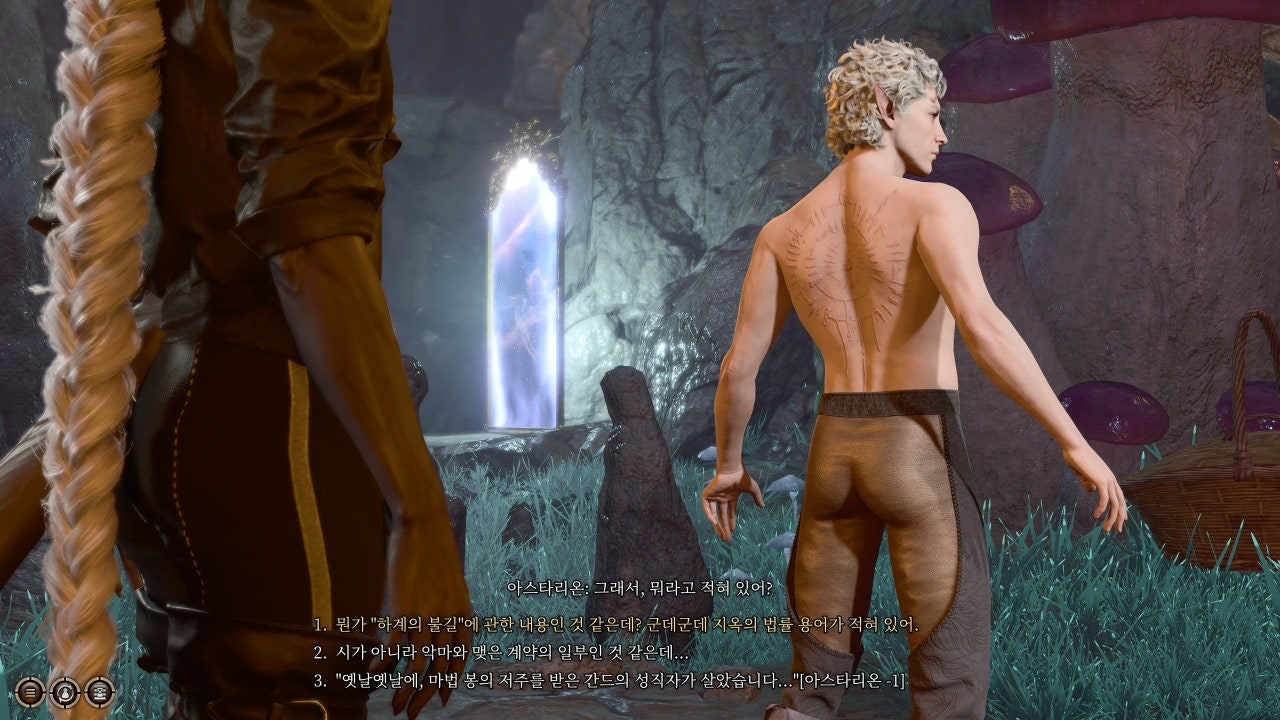
When playing as other races, the game simply has the player draw the markings on the ground and move on. However, if the player character is a tiefling, they can read Infernal and recognize that the text refers to the “flames of the Hells” along with various legal terms from infernal law. Seeing these kinds of detailed choices and reactions makes me wonder just how many possibilities Baldur’s Gate 3 accounted for. Moments like this make multiple playthroughs feel almost inevitable.
In any case, Astarion is a Neutral Evil character whose instincts are highly optimized for survival, yet his cruelty feels less like pure delight in evil and more like the residue of learned submission. He often jokes about the suffering he endured as if it were something trivial, but beneath that lies a contradiction: he longs to escape domination and indulge in freedom, yet ultimately ends up recreating another structure of domination himself.
One particularly interesting aspect is the aggression Astarion shows toward those who are weaker throughout the campaign. He responds with cynicism whenever the player chooses to help slaves, prisoners, or the oppressed, always adding a sarcastic remark. It is no surprise that these choices lower his approval.
For over two hundred years, Astarion lived as a vampire spawn under Cazador’s control. Throughout his long existence as a slave, he prayed countless times to many different gods, but no salvation ever came. During all those years, he was never once treated as someone worth rescuing. Yet once he steps out into the world, he sees that others in the same “state of bondage” are offered help by their companions. Kind-hearted people treat those who suffer as individuals who naturally deserve to be saved. To Astarion, this scene could easily appear as an unbearable injustice.
This is a textbook example of relative deprivation and the projection of negative emotions. When he sees other vulnerable people easily receiving what he himself was denied, he does not feel sympathy for them. Instead, he experiences a bitter sense of betrayal and jealousy, wondering, “Why do they deserve to be saved?”
As a result, he responds with cynicism toward companions who suggest rescuing slaves, and he refuses to place himself on the side of rescue and liberation. The moment he shows compassion toward them, he would have to confront the injustice and loss he carries within himself.
A Longing for Unconditional Acceptance


Astarion outwardly distrusts others to an extreme degree, yet at the same time he carries a contradictory longing: the desire for someone—anyone—to believe in him without conditions. When Gale reveals that there is a bomb inside his body, Astarion openly reacts with hostility, accusing him of hiding something so dangerous while claiming to be a friend. And yet, when it comes to himself—when he confesses that he is a vampire spawn who might bite the player—he clearly hopes for unconditional support and acceptance in return.
In fact, raising Astarion’s approval is surprisingly simple. If you support him in whatever he does and show that you trust him, his approval will skyrocket.
Act 2: The Boundary Between Affection and Deception
In Baldur’s Gate 3, Astarion’s romance is not a simple love story. His displays of affection initially emerge as a strategy born from deception and survival. However, once Act 2 begins, Astarion no longer treats the player as merely a tool. One can speculate that the player’s willingness to offer the unconditional acceptance he longs for leaves a deep impression on him. After all, while he is familiar with fleeting moments of passion, he has never truly received sustained affection from anyone.
In Act 2, there are events that allow the player to become Astarion’s lover if certain conditions are met. For the sake of clarity, I will divide these conditions into two routes: the Potion Merchant route and the Yurgir route.
To reach either branch, the corresponding requirements must first be fulfilled.
| Potion Merchant Route | 여르기어 분기 |
| - Enter the Moonrise Towers. - While Astarion is in the party, speak with the potion merchant Araj Oblodra. -In the dialogue choices, make it clear that Astarion is an autonomous individual and that you will not order him to obey your will. |
- Enter the Gauntlet of Shar. - Do not kill Yurgir by attacking him from stealth. - Walk directly into Yurgir’s trap, speak with him, and then defeat him. |
Regardless of which route you take, Astarion ultimately says the same thing: “Whatever this relationship is, whatever you want to call it — I want to be with you.” In that moment, he reveals a direction of feeling that even he himself seems surprised by. For a neutral-evil survivalist, this shift is both unusual and profoundly significant.
Personally, I find Astarion’s dialogue in the Potion Merchant route somewhat ambiguous. In contrast, the Yurgir route allows Astarion to express his feelings more clearly and sincerely. For players who have never romanced Astarion before, I would recommend taking the Yurgir route.
One important thing to note: even if you complete the Yurgir route first, you can still trigger the Potion Merchant route later by going to Moonrise Towers and speaking with Araj Oblodra. However, doing so will override the previous route and trigger the Potion Merchant version of the event instead. For that reason, it is recommended to avoid meeting Araj Oblodra at Moonrise Towers until after you have already entered a relationship with Astarion.
Romance Event (Potion Merchant Route)
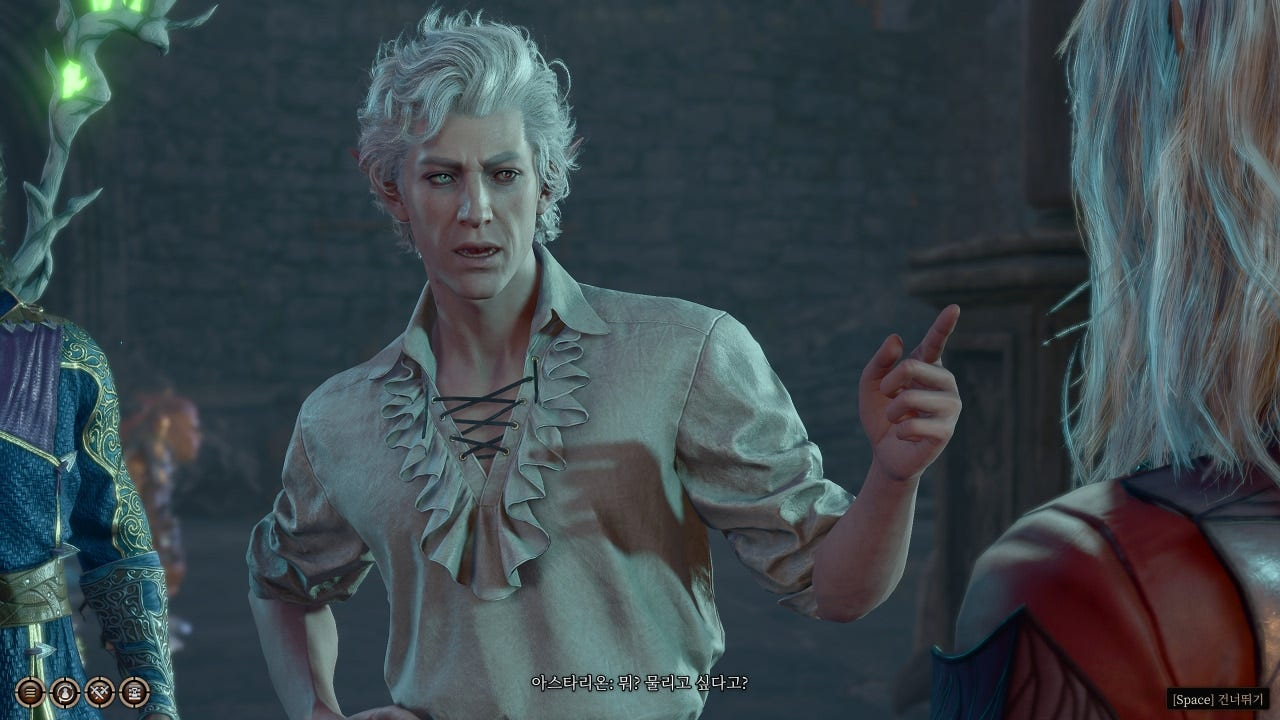

The first romance event to discuss is the Araj the potion merchant route.
At Moonrise Towers, the player’s party can encounter a potion merchant named Araj Oblodra. A drow, she casually reveals that being bitten by a vampire has always been her dream. She proposes that if Astarion drinks her blood and indulges her rather peculiar fetish, she will reward the party with a potion that permanently grants +1 Strength.
At first glance, this moment may seem like a simple quest, but several deeply uncomfortable elements lie beneath it. Araj wants Astarion to act in order to satisfy her own fetish. Yet she does not make the offer to Astarion—she makes it to the player. Her gaze never leaves the player character, as though the player were the owner of this vampire spawn named Astarion. Misinterpreting the relationship between the player and Astarion as one of master and servant, she never asks for Astarion’s opinion. This is despite the fact that Astarion clearly expresses that he does not want to do it.
Astarion, of course, could simply refuse. Yet even if the player pressures him with something like “Come on, just close your eyes and do it,” he ultimately gives in, complaining all the while. He insists that Araj smells awful and that he absolutely does not want to do it. But if the player pushes him, he straightens his voice and begins whispering to Araj in a seductive tone before finally drinking her blood. (He almost immediately gags afterward, of course.)
For Astarion, this act functions as a trigger that repeats his experience of slavery. Even when he did not want to, he was forced to become a “seducer” for Cazador. Luring victims into despair was his life, and selling himself in the process was part of that same existence. In that sense, the player saying, “Just close your eyes and bite her—she’ll give us something good,” effectively becomes the same as saying, “If we commodify you, we can easily obtain something valuable. Just sell your body like you always have.”
Naturally, if you want to romance Astarion, you should absolutely—never—sell him out to Araj. The +1 Strength bonus is certainly a valuable reward, but it is far more important to make it clear that Astarion is not the player’s servant, and that you would never force him to do something he dislikes. When you respond this way, the event ultimately becomes a moment in which Astarion realizes that the player respects him not as a tool, but as a living person—a companion.
In that single moment, the player breaks the structure of domination that Astarion had grown accustomed to in his past.
Then, after roughly two or three days have passed, the true romance event appears. Astarion calls the player aside at night and begins to speak. Below is a text version of the dialogue from that cutscene, along with a video of the scene itself.
If you want, I can also polish this into a more “game analysis blog” style English version (the kind English-speaking BG3 analysis blogs use), which would make it read even more smoothly.
▼ Full Event Dialogue
Thank you. I really mean that.
Uh… you’re welcome?
for what you said. Whilst I was in front of that vile drow, I spent 200 years
using my body to lure pretty things back for my master.
What I wanted, how I felt about what I was doing, it never mattered.
You could have asked me to do the same. To throw myself at her. What I wanted be damned.
But you didn't. and I'm grateful.
I don’t want you to do something you don’t want to do.
It's a novel concept, I admit, and uh a little intimidating.
It would have been so easy to bite her, to just go along with what I was being.
told to do. A moment of disgust to force myself through and then I could have
carried on just like before.
That wouldn’t have been the right thing to do.
The entire reason for my existence was to seduce anything with a pulse.
And every instinct I have tells me that nothing's changed.
I'm still just a means to an end.
You made me see that I never stopped thinking like I was his slave, even in freedom.
But I'm more than that, more than a thing to be used.
The lines he speaks to the player at camp reveal his complicated psychological state with striking clarity. In that moment, he realizes something important: that there exists a choice where he does not have to offer up his body to satisfy someone else’s desires. He spent two hundred years without any sense of personal agency, but that is no longer the case. In many ways, it is the player who helps him realize this.
The player respects Astarion for who he is, regardless of the wounds he carries, the mistakes he may have made, or how cynical he appears. Experiencing that kind of acceptance becomes a powerful force in breaking through Astarion’s trauma.
“You made me see that I never stopped thinking like I was his slave, even in freedom. But I'm more than that, more than a thing to be used.”
This confession was both heartbreaking and endearing. Astarion is still Neutral Evil. If necessary, he will use others, betray them, and always place his own survival first. Yet despite all that, Astarion begins to care about the player.
At first, he thought the player was simply someone he could easily manipulate. But he gradually realizes that the player is someone who protects him—someone who cares about his dignity.
Romance Event (Yurgir Route)
The second trigger is the Yurgir route. This branch is emotionally rich—so much so that it feels appropriate to call it the “true confession scene.” By defeating Yurgir, the player allows Raphael to reveal the truth behind the scars carved into Astarion’s back.
There are several ways to deal with Yurgir. You can persuade him into killing himself without entering combat (which is the easiest method), or you can defeat him in battle. I’ve heard that if you free Yurgir instead, you won’t be able to enter this route, though I’ve never actually chosen that option myself, so please take that as secondhand information.
In any case, once Yurgir is killed and Raphael’s deal is fulfilled, a few days pass—just like in the Potion Merchant route. After two or three nights, Astarion approaches the player at camp and begins to speak.
▼ Full Event Dialogue
Do you have a moment? I think we need to talk.
Is that alright?
Oh, yes. I'm fine. I just feel awful.
Look, I had a plan. A nice, simple plan. Seduce you, sleep with you, manipulate.
your feelings so you'd never turn on me. It was easy.
Instinctive habits from 200 years of charming people.
kicked in. All you had to do was fall for it.
And all I had to do was not fall for you.
Which is where my nice, simple plan fell apart.
You're You're incredible. You You deserve something real.
I want us to be something real.
I feel the same way.
I just don't know what real looks like. Not after 200 years playing the rake.
Being close to someone, any kind of intimacy
was something I performed to lure people back for him.
Even though I know things between us are different, being with someone still
feels tainted,
still brings up those feelings of disgust and loathing.
I don't know how else to be with someone,
no matter how much I'd like to.
I was only able to see this scene on my eighth playthrough. Since Baldur’s Gate 3 allows romance with almost all companion NPCs, I had been trying different options each time I created a new playable character. Eventually, driven by curiosity about the Yurgir route I had only heard about through word of mouth, I finally witnessed this rare cutscene.
If Astarion’s confession in the Potion Merchant route is an expression of gratitude and affection toward someone who does not treat him as an object, then his confession in the Yurgir route is closer to a confession of guilt. Admitting that he originally intended to use the player, only for that plan to collapse as he ended up falling for them, creates a far more romantic atmosphere than the former. The former is about trust; the latter is about revelation.
Trust forms the foundation of mutual respect and protection, but revelation means exposing even the darkest parts of oneself. In the Yurgir route, Astarion admits that the plan he carefully constructed has failed, and that the emotions he now feels are unfamiliar and frightening to him. What moved me most in this scene was not that he declared love, but that he acknowledged how frightening love is for him—and still said, even so, he wants to stay by the player’s side.
For Astarion, seduction has always been a weapon—something he excels at and relies on with confidence. Yet in this moment, standing before the player, he loses that weapon.
Common to All Romance Routes
▼ Full Event Dialogue
1. I genuinely care about you.
2. Maybe what you really need right now isn’t a lover, but a friend.
3. Learn to enjoy sex for your own satisfaction—and enjoy it with me.
4. Maybe it would be better for you if we stopped here.
5. I only slept with you for fun. I didn’t want anything like this.
Is that true?
1. Open your heart and show him you mean it.
2. Hug him.
3. You matter to me, no matter what you’re going through.
4. We can just be together without sleeping together—until you figure things out.
Ha! That sounds like quite the challenge.
To be honest, I have no idea what we’re doing.
I don’t know what’s going to happen next, either.
But this… feels really good.
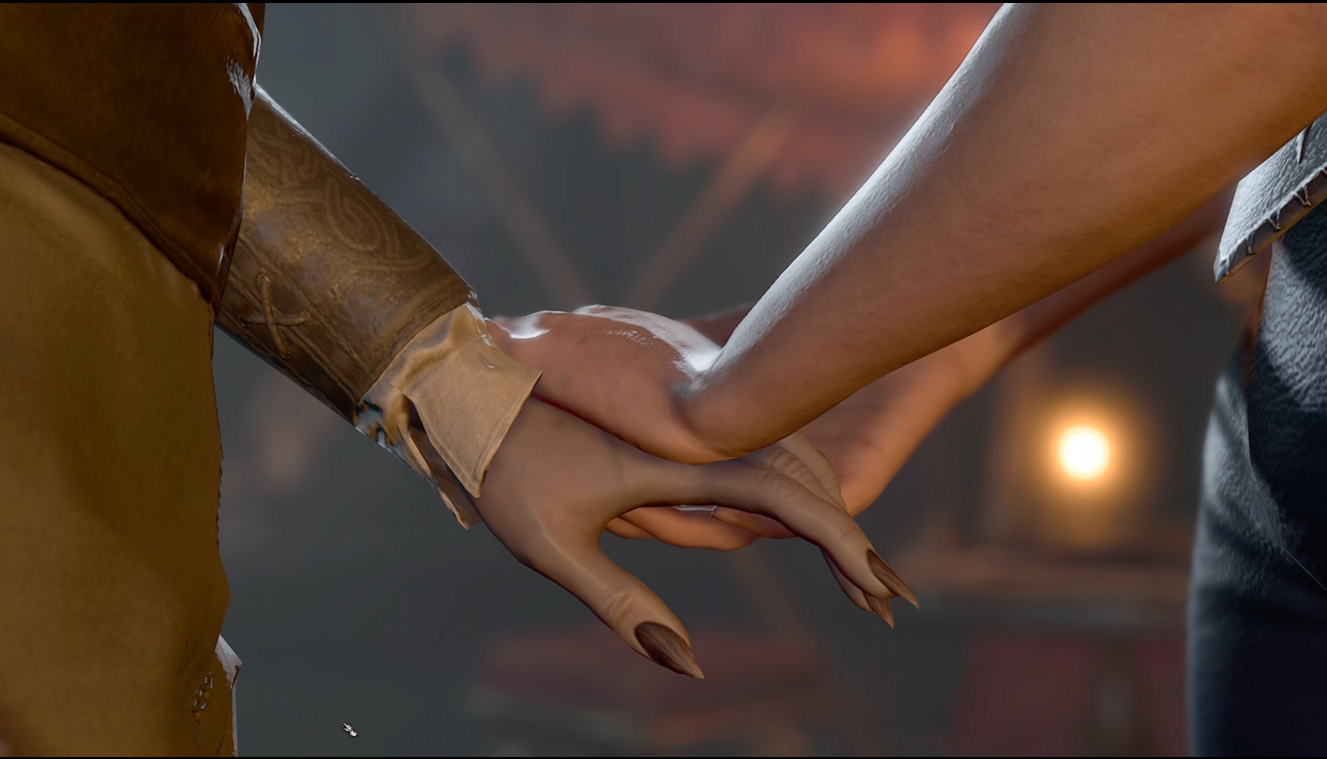
No matter which route you take, the scene ultimately ends with the same line. Neither of them tries to define what this feeling is. Astarion in particular says, “Honestly, I don’t even know what we’re doing.” Even when the player later asks, “What are we to each other?”, he doesn’t give it a clear label like “we’re lovers” or anything like that. Instead, he responds with something along the lines of: we’re simply us, and isn’t that enough?
In fact, for players who didn’t go through the Yurgir branch, Astarion’s attitude here might feel a bit underwhelming. On top of that, the scene doesn’t even involve a clear kiss. The two simply hold hands and look into each other’s eyes. It’s undeniably sweet, but it’s a little removed from what we would normally call a romantic moment.
When I played my second run, I ended up dating Astarion through the potion merchant route. In the Yurgir route, Astarion explicitly says something like, “You deserve real love,” and openly acknowledges that he’s drawn to the player. But in the potion merchant route, that line never comes up. So for me, all that happened was that we held hands, exchanged glances, and I felt proud of him for growing as a person.
The next day, suddenly being able to kiss him and being considered in a romantic relationship felt like a bolt out of the blue. I picked the dialogue option “I care about you” with a mindset closer to “aww…🥺 good job, I’m proud of you. Remember this—you’re a free person now. Of course you’re important to me, we’re companions after all.”
And somehow, that ended up roping me into a romance. (At that point it felt like breaking up immediately would just hurt him, so I awkwardly stayed in the relationship all the way to the final act and epilogue.)
Dark Urge Exclusive Event (Romance Partner or Highest-Approval Companion)
The final part of this article covers an event that can only be seen when playing as the Dark Urge. This event appears at the end of Act 2, just before entering Act 3. The condition for triggering it is simple: no matter how much the Butler urges you to kill Isobel—or even if you collapse on the ground in agony—you must absolutely refuse and keep Isobel alive.
Throughout the game, the Dark Urge kills people because of the “urge.” The character experiences pleasure from murder and destructive acts. The player can choose to give in to those impulses and become a ruthless killer, or resist them and struggle toward a more moral path. But what happens when a character who possesses such murderous impulses tries to reject that destiny? What if they resist—what if they fight back against it?
For players who enjoy stories about heroes rejecting a destructive fate, this event feels like rain after a long drought. The Dark Urge carries secrets even the player does not initially know, and those secrets are gradually revealed in late Act 2 and fully in Act 3—explaining why the Urge exists and how the character lost their memory. Act 3 in particular can almost be considered the Dark Urge’s stage. There are cutscenes unique to the Dark Urge, companions speak differently compared to when you play a custom character, and even certain villains react specifically to the Dark Urge. In many ways, this event serves as the true beginning of the Dark Urge’s unique storyline.
The event begins like this: after spending several nights camping in the cursed lands, the Dark Urge attempts to fall asleep. As they do, they notice a companion sleeping beside them. The Dark Urge’s murderous impulse grows strongest when they are not fully conscious. Whenever the urge begins to take hold, the narration itself becomes disturbingly unsettling. In this scene, the narrator says: ** Your companion sleeps peacefully beside you, like a contented slab of meat. **
The Butler suddenly appears and begins urging the player to commit murder. At this point, the player is given two choices: Kill the sleeping lover (or companion) / Refuse to kill them.
Naturally, I chose not to kill Astarion. I refused—because I love him, and I would never kill him. The Butler responds coldly: “Everyone kills the things they love.”
Because the player and Astarion are not yet openly confessing their love to one another, one of the dialogue options when refusing the Butler is: “I haven’t confessed my feelings yet. He can’t die.” 😢
The Butler continues to push the idea with twisted reasoning, suggesting that perhaps making a final confession of love while plunging the knife would be fitting.

In this event, you have to struggle quite hard to avoid killing Astarion. If you’re curious about what would happen the next day, I recommend saving your game and trying the option where you kill him.
Instead, resist the murderous urge and wake Astarion. The moment he wakes up, he teasingly says, “Well, hello. Looking for a cuddle?”—and it’s surprisingly adorable. The fact that Astarion can be this relaxed around the Dark Urge… in a way, it’s rather strange.
▼ Full Event Dialogue
Well, hello. Looking for a cuddle.
Although...you don't look entirely yourself.
What's going on that head of yours?
You’re in danger right now. We need to move—quickly.
All right, talk quickly then.
As you tell your story, fatigue fills your body.
Your head swims with the worst headache you've known.
I’m going to kill the one I care about most… you—unless you stop me.
How flattering and disturbing.
You could have talked to me before things got murderously bad. You know,
we are technically in this together. Whatever it is that's controlling you,
we can fight it. I know that better than anyone.
Anyway, after a great deal of effort, once you wake the sleeping Astarion and have the Dark Urge restrained so they cannot lose control, the rest becomes easy. No matter what the Dark Urge says to Astarion—whether they snarl or lash out—the Dark Urge is bound and cannot truly harm him.
And so Astarion stays by the Dark Urge’s side throughout the night. When morning comes and the Dark Urge finally regains their senses, Astarion releases the restraints.
▼ Full Event Dialogue
Now that you're back with us, we need to have a talk.
1.Tell him everything about your struggle against the Dark Urge.
You're not alone in this. None of us are.
We can even compare notes if you'd like.
You can hate me.
I don't hate you because this is not you. But whatever this is, you will get through it.
And I'll be here to make sure you do.
Anyway, it's a brand new day.
I'm sure we'll find lots of people for you to kill.
Of course, even when playing a custom character, Astarion can still become a deeply compelling companion—and even a lover. However, once you experience this Dark Urge–exclusive event, it’s hard not to think: Wait, there are so many more scenes here, and the emotional arc is so much richer!
In this event, the Dark Urge is someone struggling to become a better person, fighting not to be controlled by their impulses, while Astarion is someone who chooses to trust that partner. No matter what the Dark Urge may have said the previous night while consumed by the urge, Astarion does not hate them for it. Instead, he says plainly, “I don’t hate you. That wasn’t you.” He insists with confidence that “we” can overcome this together.
The Dark Urge is not the only one protecting and caring for Astarion—Astarion, in turn, embraces and supports the Dark Urge as well. This mutual dynamic is what makes their story shine even brighter. Even in the moments when neither of them can quite bring themselves to call it love.
I ended up rambling quite a bit. Between transcribing the dialogue and writing my impressions, the post has grown longer than I expected—yet I’ve only covered about half of what I wanted to discuss. Next time, I plan to focus on Astarion in Act 3, comparing and analyzing the Ascended and Non-Ascended paths.
To say this in advance: I’m not particularly fond of Astarion’s Ascension. When I first chose to ascend him, my reaction went beyond simple dislike—it felt more like a profound sense of betrayal. I spent a lot of time thinking about why it felt so out of character, and I probably gave him a million imaginary thumbs-downs because of it. But now, after about a year has passed, I think I can finally write about Ascended Astarion with a slightly more level-headed perspective.
'영화·게임·애니 > 심층 분석' 카테고리의 다른 글
| [캐릭터 분석] <발더스 게이트 3>아스타리온 캐릭터 분석: 아스타리온 안쿠닌에 대해 알아보자 -2 (3막, 승천) (1) | 2026.02.24 |
|---|---|
| [캐릭터 분석] <발더스 게이트 3>아스타리온 캐릭터 분석: 아스타리온 안쿠닌에 대해 알아보자 -1 (1막~2막, 연인, 더지이벤트까지) (7) | 2025.08.19 |
| [영화 리뷰/ 분석] <베놈:라스트 댄스> : 죽음이 둘을 갈라놓을 때까지! (6) | 2024.11.12 |
| [영화 분석]<샹치 : 텐 링즈의 전설>: 난은 왜 샹치에게 엄마를 닮았다고 했을까? (6) | 2024.11.07 |


